Abbiamo già visto nel post precedente che il past simple si può formare grazie all'uso dei verbi regolari.
Ma ci sono alcuni verbi che sono irregolari. I verbi irregolari e regolari concorrono anche alla formazione del past participle (participio passato), ma mentre i verbi regolari mantengono la desinenza -ed, i verbi irregolari hanno forme proprie al simple past e al pastparticiple.
I verbi irregolari non hanno regole , godono di vita propria, perciò l'unica soluzione per saperli è impararli a memoria. Ecco un elenco dei verbi irregolari più utilizzati:
Il simple past viene usato per esprimere un'azione svoltasi in un periodo di tempo determinato, interamente trascorso.
Il simple past corrisponde ai seguenti tempi italiani del modo indicativo:
- imperfetto: When I was young, I often played with my sister. Quando ero piccolo, giocavo spesso con mia sorella.
- passato remoto: He broke the chair. Lui ruppe la sedia.
- passato prossimo: The train left ten minutes ago. Il treno è partito dieci minuti fa. Il simple past si forma attraverso: - verbi regolari o verbi irregolari
- verbi regolari: verbi che aggiungono la desinenza -ed all'infinito senza to. Presentano una sola forma per tutte le persone. Esistono alcune variazioni ortografiche: - i verbi terminanti in -e aggiungono -d:
like liked ; tie tied
- i verbi monosillabici terminanti con una sola consonante preceduta da una sola vocale raddoppiano la consonante stessa:
stop stopped
- Non raddoppiano i monosillabici che terminano in -w e -x:
box boxed - I verbi bisillabici terminanti con una sola consonante preceduta da una sola vocale raddoppiano la consonante quando l'accento cade sull'ultima sillaba:
prefer preferred ; refer referred -to workhisp e to handicap raddoppiano la consonante finale nonostante l'accento cada sulla prima sillaba.
- la -y finale preceduta da una consonante si trasforma in -i prima di -ed:
study studied ; try tried - la -y finale preceduta da vocale resta invariata:
play played ; stay stayed - Nei verbi terminanti in -l, la consonante finale viene raddoppiata quando è preceduta da una sola vocale:
travel ; travelled
Alcuni verbi, come to fuel e to dial raddoppiano la -l finale nonostante sia preceduta da due vocali.
- I verbi terminanti in -c aggiungono una -k davanti al suffisso -ed:
mimic mimicked ; panic panicked
Tom Bertram had of late spent so little of his time at
home, that he could be only nominally missed; and Lady Bertram was soon
astonished to find how very well they did even without his father, how
well Edmund could supply his place in carving, talking to the steward,
writing to the attorney, settling with the servants, and equally saving
her from all possible fatigue or exertion in every particular, but that
of directing her letters.
The earliest intelligence of the travellers' safe
arrival at Antigua after a favourable voyage, was received; though not
before Mrs. Norris had been indulging in very dreadful fears, and trying
to make Edmund participate them whenever she could get him alone; and
as she depended on being the first person made acquainted with any fatal
catastrophe, she had already arranged the manner of breaking it to all
the others, when Sir Thomas's assurances of their both being alive and
well, made it necessary to lay by her agitation and affectionate
preparatory speeches for a while.
The winter came and passed without their being
called for; the accounts continued perfectly good; - and Mrs. Norris in
promoting gaieties for her nieces, assisting their toilets, displaying
their accomplishments, and looking about for their future husbands, had
so much to do as, in addition to all her own household cares, some
interference in those of her sister, and Mrs. Grant's wasteful doings to
overlook, left her very little occasion to be occupied in fears for the
absent.
The Miss Bertrams were now fully established among
the belles of the neighbourhood; and as they joined to beauty and
brilliant acquirements a manner naturally easy, and carefully formed to
general civility and obligingness, they possessed its favour as well as
its admiration. Their vanity was in such good order, that they seemed to
be quite free from it, and gave themselves no airs; while the praises
attending such behaviour, secured and brought round by their aunt,
served to strengthen them in believing they had no faults.
Lady Bertram did not go into public with her
daughters. She was too indolent even to accept a mother's gratification
in witnessing their success and enjoyment at the expense of any personal
trouble, and the charge was made over to her sister, who desired
nothing better than a post of such honourable representation, and very
thoroughly relished the means it afforded her of mixing in society
without having horses to hire.
Fanny had no share in the festivities of the
season; but she enjoyed being avowedly useful as her aunt's companion,
when they called away the rest of the family; and as Miss Lee had left
Mansfield, she naturally became every thing to Lady Bertram during the
night of a ball or a party. She talked to her, listened to her, read to
her; and the tranquillity of such evenings, her perfect security in such
a tête-à-tête from any sound of unkindness, was unspeakably
welcome to a mind which had seldom known a pause in its alarms or
embarrassments. As to her cousins' gaieties, she loved to hear an
account of them, especially of the balls, and whom Edmund had danced
with; but thought too lowly of her own situation to imagine she should
ever be admitted to the same, and listened therefore without an idea of
any nearer concern in them. Upon the whole, it was a comfortable winter
to her; for though it brought no William to England, the never failing
hope of his arrival was worth much.
The ensuing spring deprived her of her valued
friend the old grey pony, and for some time she was in danger of feeling
the loss in her health as well as in her affections, for in spite of
the acknowledged importance of her riding on horseback, no measures were
taken for mounting her again, "because," as it was observed by her
aunts, "she might ride one of her cousin's horses at any time when they
did not want them;" and as the Miss Bertrams regularly wanted their
horses every fine day, and had no idea of carrying their obliging
manners to the sacrifice of any real pleasure, that time of course,
never came. They took their cheerful rides in the fine mornings of April
and May; and Fanny either sat at home the whole day with one aunt, or
walked beyond her strength at the instigation of the other; Lady Bertram
holding exercise to be as unnecessary for every body as it was
unpleasant to herself; and Mrs. Norris, who was walking all day,
thinking every body ought to walk as much. Edmund was absent at this
time, or the evil would have been earlier remedied. When he returned to
understand how Fanny was situated, and perceived its ill effects, there
seemed with him but one thing to be done, and that "Fanny must have a
horse," was the resolute declaration with which he opposed whatever
could be urged by the supineness of his mother, or the economy of his
aunt, to make it appear unimportant. Mrs. Norris could not help thinking
that some steady old thing might be found among the numbers belonging
to the Park, that would do vastly well, or that one might be borrowed of
the steward, or that perhaps Dr. Grant might now and then lend them the
poney he sent to the post. She could not but consider it as absolutely
unnecessary, and even improper, that Fanny should have a regular lady's
horse of her own in the style of her cousins. She was sure Sir Thomas
had never intended it; and she must say, that to be making such a
purchase in his absence, and adding to the great expenses of his stable
at a time when a large part of his income was unsettled, seemed to her
very unjustifiable. "Fanny must have a horse," was Edmund's only reply.
Mrs. Norris could not see it in the same light. Lady Bertram did; she
entirely agreed with her son as to the necessity of it, and as to its
being considered necessary by his father; - she only pleaded against
there being any hurry; she only wanted him to wait till Sir Thomas's
return, and then Sir Thomas might settle it all himself. He would be at
home in September, and where would be the harm of only waiting till
September?
Though Edmund was much more displeased with his
aunt than with his mother, as evincing least regard for her niece, he
could not help paying more attention to what she said, and at length
determined on a method of proceeding which would obviate the risk of his
father's thinking he had done too much, and at the same time procure
for Fanny the immediate means of exercise, which he could not bear she
should be without. He had three horses of his own, but not one that
would carry a woman. Two of them were hunters; the third, a useful
road-horse: this third he resolved to exchange for one that his cousin
might ride; he knew where such a one was to be met with; and having once
made up his mind, the whole business was soon completed. The new mare
proved a treasure; with a very little trouble, she became exactly
calculated for the purpose, and Fanny was then put in almost full
possession of her. She had not supposed before, that any thing could
ever suit her like the old grey poney; but her delight in Edmund's mare
was far beyond any former pleasure of the sort; and the addition it was
ever receiving in the consideration of that kindness from which her
pleasure sprung, was beyond all her words to express. She regarded her
cousin as an example of every thing good and great, as possessing worth,
which no one but herself could ever appreciate, and as entitled to such
gratitude from her, as no feelings could be strong enough to pay. Her
sentiments towards him were compounded of all that was respectful,
grateful, confiding, and tender.
As the horse continued in name as well as fact, the
property of Edmund, Mrs. Norris could tolerate its being for Fanny's
use; and had Lady Bertram ever thought about her own objection again, he
might have been excused in her eyes, for not waiting till Sir Thomas's
return in September, for when September came, Sir Thomas was still
abroad, and without any near prospect of finishing his business.
Unfavourable circumstances had suddenly arisen at a moment when he was
beginning to turn all his thoughts towards England, and the very great
uncertainty in which every thing was then involved, determined him on
sending home his son, and waiting the final arrangement by himself. Tom
arrived safely, bringing an excellent account of his father's health;
but to very little purpose, as far as Mrs. Norris was concerned. Sir
Thomas's sending away his son, seemed to her so like a parent's care,
under the influence of a foreboding of evil to himself, that she could
not help feeling dreadful presentiments; and as the long evenings of
autumn came on, was so terribly haunted by these ideas, in the sad
solitariness of her cottage, as to be obliged to take daily refuge in
the dining-room of the park. The return of winter engagements, however,
was not without its effect; and in the course of their progress, her
mind became so pleasantly occupied in superintending the fortunes of her
eldest niece, as tolerably to quiet her nerves. "If poor Sir Thomas
were fated never to return, it would be peculiarly consoling to see
their dear Maria well married," she very often thought; always when they
were in the company of men of fortune, and particularly on the
introduction of a young man who had recently succeeded to one of the
largest estates and finest places in the country.
Mr. Rushworth was from the first struck with the
beauty of Miss Bertram, and being inclined to marry, soon fancied
himself in love. He was a heavy young man, with not more than common
sense; but as there was nothing disagreeable in his figure or address,
the young lady was well pleased with her conquest. Being now in her
twenty-first year, Maria Bertram was beginning to think matrimony a
duty; and as a marriage with Mr. Rushworth would give her the enjoyment
of a larger income than her father's, as well as ensure her the house in
town, which was now a prime object, it became, by the same rule of
moral obligation, her evident duty to marry Mr. Rushworth if she could.
Mrs. Norris was most zealous in promoting the match, by every suggestion
and contrivance, likely to enhance its desirableness to either party;
and, among other means, by seeking an intimacy with the gentleman's
mother, who at present lived with him, and to whom she even forced Lady
Bertram to go through ten miles of indifferent road, to pay a morning
visit. It was not long before a good understanding took place between
this lady and herself. Mrs. Rushworth acknowledged herself very desirous
that her son should marry, and declared that of all the young ladies
she had ever seen, Miss Bertram seemed, by her amiable qualities and
accomplishments, the best adapted to make him happy. Mrs. Norris
accepted the compliment, and admired the nice discernment of character
which could so well distinguish merit. Maria was indeed the pride and
delight of them all - perfectly faultless - an angel; and of course, so
surrounded by admirers, must be difficult in her choice; but yet as far
as Mrs. Norris could allow herself to decide on so short an
acquaintance, Mr. Rushworth appeared precisely the young man to deserve
and attach her.
After dancing with each other at a proper number of
balls, the young people justified these opinions, and an engagement,
with a due reference to the absent Sir Thomas, was entered into, much to
the satisfaction of their respective families, and of the general
lookers-on of the neighbourhood, who had, for many weeks past, felt the
expediency of Mr. Rushworth's marrying Miss Bertram.
It was some months before Sir Thomas's consent
could be received; but in the mean while, as no one felt a doubt of his
most cordial pleasure in the connection, the intercourse of the two
families was carried on without restraint, and no other attempt made at
secrecy than Mrs. Norris's talking of it every where as a matter not to
be talked of at present.
Edmund was the only one of the family who could see
a fault in the business; but no representation of his aunt's could
induce him to find Mr. Rushworth a desirable companion. He could allow
his sister to be the best judge of her own happiness, but he was not
pleased that her happiness should centre in a large income; nor could he
refrain from often saying to himself, in Mr. Rushworth's company, "If
this man had not twelve thousand a year, he would be a very stupid
fellow."
Sir Thomas, however, was truly happy in the
prospect of an alliance so unquestionably advantageous, and of which he
heard nothing but the perfectly good and agreeable. It was a connection
exactly of the right sort; in the same county, and the same interest;
and his most hearty concurrence was conveyed as soon as possible. He
only conditioned that the marriage should not take place before his
return, which he was again looking eagerly forward to. He wrote in
April, and had strong hopes of settling every thing to his entire
satisfaction, and leaving Antigua before the end of the summer.
Such was the state of affairs in the month of July,
and Fanny had just reached her eighteenth year, when the society of the
village received an addition in the brother and sister of Mrs. Grant, a
Mr. and Miss Crawford, the children of her mother by a second marriage.
They were young people of fortune. The son had a good estate in
Norfolk, the daughter twenty thousand pounds. As children, their sister
had been always very fond of them; but, as her own marriage had been
soon followed by the death of their common parent, which left them to
the care of a brother of their father, of whom Mrs. Grant knew nothing,
she had scarcely seen them since. In their uncle's house they had found a
kind home. Admiral and Mrs. Crawford, though agreeing in nothing else,
were united in affection for these children, or at least were no farther
adverse in their feelings than that each had their favourite, to whom
they showed the greatest fondness of the two. The Admiral delighted in
the boy, Mrs. Crawford doted on the girl; and it was the lady's death
which now obliged her protegée, after some months further trial
at her uncle's house, to find another home. Admiral Crawford was a man
of vicious conduct, who chose, instead of retaining his niece, to bring
his mistress under his own roof; and to this Mrs. Grant was indebted for
her sister's proposal of coming to her, a measure quite as welcome on
one side, as it could be expedient on the other; for Mrs. Grant having
by this time run through the usual resources of ladies residing in the
country without a family of children; having more than filled her
favourite sitting-room with pretty furniture, and made a choice
collection of plants and poultry, was very much in want of some variety
at home. The arrival, therefore, of a sister whom she had always loved,
and now hoped to retain with her as long as she remained single, was
highly agreeable; and her chief anxiety was lest Mansfield should not
satisfy the habits of a young woman who had been mostly used to London.
Miss Crawford was not entirely free from similar
apprehensions, though they arose principally from doubts of her sister's
style of living and tone of society; and it was not till after she had
tried in vain to persuade her brother to settle with her at his own
country-house, that she could resolve to hazard herself among her other
relations. To any thing like a permanence of abode, or limitation of
society, Henry Crawford had, unluckily, a great dislike; he could not
accommodate his sister in an article of such importance, but he escorted
her, with the utmost kindness, into Northamptonshire, and as readily
engaged to fetch her away again at half an hour's notice, whenever she
were weary of the place.
The meeting was very satisfactory on each side.
Miss Crawford found a sister without preciseness or rusticity - a
sister's husband who looked the gentleman, and a house commodious and
well fitted up; and Mrs. Grant received in those whom she hoped to love
better than ever, a young man and woman of very prepossessing
appearance. Mary Crawford was remarkably pretty; Henry, though not
handsome, had air and countenance; the manners of both were lively and
pleasant, and Mrs. Grant immediately gave them credit for every thing
else. She was delighted with each, but Mary was her dearest object; and
having never been able to glory in beauty of her own, she thoroughly
enjoyed the power of being proud of her sister's. She had not waited her
arrival to look out for a suitable match for her; she had fixed on Tom
Bertram; the eldest son of a Baronet was not too good for a girl of
twenty thousand pounds, with all the elegance and accomplishments which
Mrs. Grant foresaw in her; and being a warm-hearted, unreserved woman,
Mary had not been three hours in the house before she told her what she
had planned.
Miss Crawford was glad to find a family of such
consequence so very near them, and not at all displeased either at her
sister's early care, or the choice it had fallen on. Matrimony was her
object, provided she could marry well, and having seen Mr. Bertram in
town, she knew that objection could no more be made to his person than
to his situation in life. While she treated it as a joke, therefore, she
did not forget to think of it seriously. The scheme was soon repeated
to Henry.
"And now," added Mrs. Grant, "I have thought of
something to make it complete. I should dearly love to settle you both
in this country; and therefore, Henry, you shall marry the youngest Miss
Bertram, a nice, handsome, good-humoured, accomplished girl, who will
make you very happy."
Henry bowed and thanked her.
"My dear sister," said Mary, "if you can persuade
him into any thing of the sort, it will be a fresh matter of delight to
me, to find myself allied to any body so clever, and I shall only regret
that you have not half-a-dozen daughters to dispose of. If you can
persuade Henry to marry, you must have the address of a Frenchwoman. All
that English abilities can do, has been tried already. I have three
very particular friends who have been all dying for him in their turn;
and the pains which they, their mothers (very clever women,) as well as
my dear aunt and myself, have taken to reason, coax, or trick him into
marrying, is inconceivable! He is the most horrible flirt that can be
imagined. If your Miss Bertrams do not like to have their hearts broke,
let them avoid Henry."
"My dear brother, I will not believe this of you."
"No, I am sure you are too good. You will be kinder
than Mary. You will allow for the doubts of youth and inexperience. I
am of a cautious temper, and unwilling to risk my happiness in a hurry.
Nobody can think more highly of the matrimonial state than myself. I
consider the blessing of a wife as most justly described in those
discreet lines of the poet, "'Heaven's last best gift.'"
"There, Mrs. Grant, you see how he dwells on one
word, and only look at his smile. I assure you he is very detestable -
the admiral's lessons have quite spoiled him."
"I pay very little regard," said Mrs. Grant, "to
what any young person says on the subject of marriage. If they profess a
disinclination for it, I only set it down that they have not yet seen
the right person."
Dr. Grant laughingly congratulated Miss Crawford on feeling no disinclination to the state herself.
"Oh! yes, I am not at all ashamed of it. I would
have every body marry if they can do it properly; I do not like to have
people throw themselves away; but every body should marry as soon as
they can do it to advantage."
The first event of any importance in the family was
the death of Mr. Norris, which happened when Fanny was about fifteen,
and necessarily introduced alterations and novelties. Mrs. Norris, on
quitting the parsonage, removed first to the park, and afterwards to a
small house of Sir Thomas's in the village, and consoled herself for the
loss of her husband by considering that she could do very well without
him; and for her reduction of income by the evident necessity of
stricter economy.
The living was hereafter for Edmund, and had his
uncle died a few years sooner, it would have been duly given to some
friend to hold till he were old enough for orders. But Tom's
extravagance had, previous to that event, been so great as to render a
different disposal of the next presentation necessary, and the younger
brother must help to pay for the pleasures of the elder. There was
another family-living actually held for Edmund; but though this
circumstance had made the arrangement somewhat easier to Sir Thomas's
conscience, he could not but feel it to be an act of injustice, and he
earnestly tried to impress his eldest son with the same conviction, in
the hope of its producing a better effect than any thing he had yet been
able to say or do.
"I blush for you, Tom," said he, in his most
dignified manner; "I blush for the expedient which I am driven on, and I
trust I may pity your feelings as a brother on the occasion. You have
robbed Edmund for ten, twenty, thirty years, perhaps for life, of more
than half the income which ought to be his. It may hereafter be in my
power, or in your's (I hope it will), to procure him better preferment;
but it must not be forgotten, that no benefit of that sort would have
been beyond his natural claims on us, and that nothing can, in fact, be
an equivalent for the certain advantage which he is now obliged to
forego through the urgency of your debts."
Tom listened with some shame and some sorrow; but
escaping as quickly as possible, could soon with cheerful selfishness
reflect, 1st, that he had not been half so much in debt as some of his
friends; 2dly, that his father had made a most tiresome piece of work of
it; and 3dly, that the future incumbent, whoever he might be, would, in
all probability, die very soon.
On Mr. Norris's death the presentation became the
right of a Dr. Grant, who came consequently to reside at Mansfield; and
on proving to be a hearty man of forty-five, seemed likely to disappoint
Mr. Bertram's calculations. But "no, he was a short-neck'd, apoplectic
sort of fellow, and, plied well with good things, would soon pop off."
He had a wife about fifteen years his junior, but
no children, and they entered the neighbourhood with the usual fair
report of being very respectable, agreeable people.
The time was now come when Sir Thomas expected his
sister-in-law to claim her share in their niece, the change in Mrs.
Norris's situation, and the improvement in Fanny's age, seeming not
merely to do away any former objection to their living together, but
even to give it the most decided eligibility; and as his own
circumstances were rendered less fair than heretofore, by some recent
losses on his West India estate, in addition to his eldest son's
extravagance, it became not undesirable to himself to be relieved from
the expense of her support, and the obligation of her future provision.
In the fullness of his belief that such a thing must be, he mentioned
its probability to his wife; and the first time of the subject's
occurring to her again, happening to be when Fanny was present, she
calmly observed to her, "So, Fanny, you are going to leave us, and live
with my sister. How shall you like it?"
Fanny was too much surprised to do more than repeat her aunt's words, "Going to leave you?"
"Yes, my dear; why should you be astonished? You
have been five years with us, and my sister always meant to take you
when Mr. Norris died. But you must come up and tack on my patterns all
the same."
The news was as disagreeable to Fanny as it had
been unexpected. She had never received kindness from her aunt Norris,
and could not love her.
"I shall be very sorry to go away," said she, with a faltering voice.
"Yes, I dare say you will; that's natural enough. I suppose you have had as little to vex you, since you came into this house, as any creature in the world."
"I hope I am not ungrateful, aunt," said Fanny modestly.
"No, my dear; I hope not. I have always found you a very good girl."
"And am I never to live here again?"
"Never, my dear; but you are sure of a comfortable
home. It can make very little difference to you, whether you are in one
house or the other."
Fanny left the room with a very sorrowful heart;
she could not feel the difference to be so small, she could not think of
living with her aunt with any thing like satisfaction. As soon as she
met with Edmund she told him her distress.
"Cousin," said she, "something is going to happen
which I do not like at all; and though you have often persuaded me into
being reconciled to things that I disliked at first, you will not be
able to do it now. I am going to live entirely with my aunt Norris."
"Indeed!"
"Yes; my aunt Bertram has just told me so. It is
quite settled. I am to leave Mansfield Park, and go to the White house, I
suppose, as soon as she is removed there."
"Well, Fanny, and if the plan were not unpleasant to you, I should call it an excellent one."
"Oh! Cousin!"
"It has every thing else in its favour. My aunt is
acting like a sensible woman in wishing for you. She is choosing a
friend and companion exactly where she ought, and I am glad her love of
money does not interfere. You will be what you ought to be to her. I
hope it does not distress you very much, Fanny."
"Indeed it does: I cannot like it. I love this
house and every thing in it: I shall love nothing there. You know how
uncomfortable I feel with her."
"I can say nothing for her manner to you as a
child; but it was the same with us all, or nearly so. She never knew how
to be pleasant to children. But you are now of an age to be treated
better; I think she is behaving better already; and when you are her only companion, you must be important to her."
"I can never be important to any one."
"What is to prevent you?"
"Every thing - my situation - my foolishness and awkwardness."
"As to your foolishness and awkwardness, my dear
Fanny, believe me, you never have a shadow of either, but in using the
words so improperly. There is no reason in the world why you should not
be important where you are known. You have good sense, and a sweet
temper, and I am sure you have a grateful heart, that could never
receive kindness without wishing to return it. I do not know any better
qualifications for a friend and companion."
"You are too kind," said Fanny, colouring at such
praise; "how shall I ever thank you as I ought, for thinking so well of
me. Oh! cousin, if I am to go away, I shall remember your goodness, to
the last moment of my life."
"Why, indeed, Fanny, I should hope to be remembered
at such a distance as the White house. You speak as if you were going
two hundred miles off instead of only across the park. But you will
belong to us almost as much as ever. The two families will be meeting
every day in the year. The only difference will be, that, living with
your aunt, you will necessarily be brought forward, as you ought to be. Here, there are too many, whom you can hide behind; but with her you will be forced to speak for yourself."
"Oh! I do not say so."
"I must say it, and say it with pleasure. Mrs.
Norris is much better fitted than my mother for having the charge of you
now. She is of a temper to do a great deal for any body she really
interests herself about, and she will force you to do justice to your
natural powers."
Fanny sighed, and said, "I cannot see things as you
do; but I ought to believe you to be right rather than myself, and I am
very much obliged to you for trying to reconcile me to what must be. If
I could suppose my aunt really to care for me, it would be delightful
to feel myself of consequence to any body! - Here, I know I am of none, and yet I love the place so well."
"The place, Fanny, is what you will not quit,
though you quit the house. You will have as free a command of the park
and gardens as ever. Even your constant little heart need not
take fright at such a nominal change. You will have the same walks to
frequent, the same library to choose from, the same people to look at,
the same horse to ride."
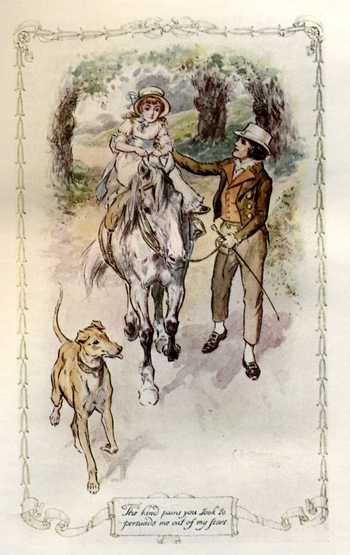
"Very true. Yes, dear old grey poney. Ah! cousin,
when I remember how much I used to dread riding, what terrors it gave me
to hear it talked of as likely to do me good; (Oh! how I have trembled
at my uncle's opening his lips if horses were talked of) and then think
of the kind pains you took to reason and persuade me out of my fears,
and convince me that I should like it after a little while, and feel how
right you proved to be, I am inclined to hope you may always prophesy
as well."
"And I am quite convinced that your being with Mrs.
Norris, will be as good for your mind, as riding has been for your
health - and as much for your ultimate happiness too."
So ended their discourse, which, for any very
appropriate service it could render Fanny, might as well have been
spared, for Mrs. Norris had not the smallest intention of taking her. It
had never occurred to her, on the present occasion, but as a thing to
be carefully avoided. To prevent its being expected, she had fixed on
the smallest habitation which could rank as genteel among the buildings
of Mansfield parish, the White house being only just large enough to
receive herself and her servants, and allow a spare room for a friend,
of which she made a very particular point; - the spare rooms at the
parsonage had never been wanted, but the absolute necessity of a
spare-room for a friend was now never forgotten. Not all her
precautions, however, could save her from being suspected of something
better; or, perhaps, her very display of the importance of a spare-room
might have misled Sir Thomas to suppose it really intended for Fanny.
Lady Bertram soon brought the matter to a certainty by carelessly
observing to Mrs. Norris, -
"I think, sister, we need not keep Miss Lee any longer, when Fanny goes to live with you."
Mrs. Norris almost started. "Live with me, dear Lady Bertram, what do you mean?"
"Is she not to live with you? - I thought you had settled it with Sir Thomas?"
"Me! never. I never spoke a syllable about it to
Sir Thomas, nor he to me. Fanny live with me! the last thing in the
world for me to think of, or for any body to wish that really knows us
both. Good heaven! what could I do with Fanny? - Me! a poor helpless,
forlorn widow, unfit for any thing, my spirits quite broke down, what
could I do with a girl at her time of life, a girl of fifteen! the very
age of all others to need most attention and care, and put the
cheerfullest spirits to the test. Sure Sir Thomas could not seriously
expect such a thing! Sir Thomas is too much my friend. Nobody that
wishes me well, I am sure, would propose it. How came Sir Thomas to
speak to you about it?"
"Indeed, I do not know. I suppose he thought it best."
"But what did he say? - He could not say he wished me to take Fanny. I am sure in his heart he could not wish me to do it."
"No, he only said he thought it very likely - and I
thought so too. We both thought it would be a comfort to you. But if
you do not like it, there is no more to be said. She is no incumbrance
here."
"Dear sister! If you consider my unhappy state, how
can she be any comfort to me? Here am I a poor desolate widow, deprived
of the best of husbands, my health gone in attending and nursing him,
my spirits still worse, all my peace in this world destroyed, with
hardly enough to support me in the rank of a gentlewoman, and enable me
to live so as not to disgrace the memory of the dear departed - what
possible comfort could I have in taking such a charge upon me as Fanny!
If I could wish it for my own sake, I would not do so unjust a thing by
the poor girl. She is in good hands, and sure of doing well. I must
struggle through my sorrows and difficulties as I can."
"Then you will not mind living by yourself quite alone?"
"Dear Lady Bertram! what am I fit for but solitude?
Now and then I shall hope to have a friend in my little cottage (I
shall always have a bed for a friend); but the most part of my future
days will be spent in utter seclusion. If I can but make both ends meet,
that's all I ask for."
"I hope, sister, things are not so very bad with you neither - considering Sir Thomas says you will have six hundred a year."
"Lady Bertram, I do not complain. I know I cannot
live as I have done, but I must retrench where I can, and learn to be a
better manager. I have been a liberal housekeeper enough, but I
shall not be ashamed to practise economy now. My situation is as much
altered as my income. A great many things were due from poor Mr. Norris
as clergyman of the parish, that cannot be expected from me. It is
unknown how much was consumed in our kitchen by odd comers and goers. At
the White house, matters must be better looked after. I must
live within my income, or I shall be miserable; and I own it would give
me great satisfaction to be able to do rather more - to lay by a little
at the end of the year."
"I dare say you will. You always do, don't you?"
"My object, Lady Bertram, is to be of use to those
that come after me. It is for your children's good that I wish to be
richer. I have nobody else to care for, but I should be very glad to
think I could leave a little trifle among them, worth their having."
"You are very good, but do not trouble yourself
about them. They are sure of being well provided for. Sir Thomas will
take care of that."
"Why, you know Sir Thomas's means will be rather straitened, if the Antigua estate is to make such poor returns."
"Oh! that will soon be settled. Sir Thomas has been writing about it, I know."
"Well, Lady Bertram," said Mrs. Norris, moving to
go, "I can only say that my sole desire is to be of use to your family -
and so if Sir Thomas should ever speak again about my taking Fanny, you
will be able to say, that my health and spirits put it quite out of the
question - besides that, I really should not have a bed to give her,
for I must keep a spare room for a friend."
Lady Bertram repeated enough of this conversation
to her husband, to convince him how much he had mistaken his
sister-in-law's views; and she was from that moment perfectly safe from
all expectation, or the slightest allusion to it from him. He could not
but wonder at her refusing to do any thing for a niece, whom she had
been so forward to adopt; but as she took early care to make him, as
well as Lady Bertram, understand that whatever she possessed was
designed for their family, he soon grew reconciled to a distinction,
which at the same time that it was advantageous and complimentary to
them, would enable him better to provide for Fanny himself.
Fanny soon learnt how unnecessary had been her
fears of a removal; and her spontaneous, untaught felicity on the
discovery, conveyed some consolation to Edmund for his disappointment in
what he had expected to be so essentially serviceable to her. Mrs.
Norris took possession of the White house, the Grants arrived at the
parsonage, and these events over, every thing at Mansfield went on for
some time as usual.
The Grants showing a disposition to be friendly and
sociable, gave great satisfaction in the main among their new
acquaintance. They had their faults, and Mrs. Norris soon found them
out. The Dr. was very fond of eating, and would have a good dinner every
day; and Mrs. Grant, instead of contriving to gratify him at little
expense, gave her cook as high wages as they did at Mansfield Park, and
was scarcely ever seen in her offices. Mrs. Norris could not speak with
any temper of such grievances, nor of the quantity of butter and eggs
that were regularly consumed in the house. "Nobody loved plenty and
hospitality more than herself - nobody more hated pitiful doings - the
parsonage she believed had never been wanting in comforts of any sort,
had never borne a bad character in her time, but this was a way of going on that she could not understand. A fine lady in a country parsonage was quite out of place. Her
store-room she thought might have been good enough for Mrs. Grant to go
into. Enquire where she would, she could not find out that Mrs. Grant
had ever had more than five thousand pounds."
Lady Bertram listened without much interest to this
sort of invective. She could not enter into the wrongs of an economist,
but she felt all the injuries of beauty in Mrs. Grant's being so well
settled in life without being handsome, and expressed her astonishment
on that point almost as often, though not so diffusely, as Mrs. Norris
discussed the other.
These opinions had been hardly canvassed a year,
before another event arose of such importance in the family, as might
fairly claim some place in the thoughts and conversation of the ladies.
Sir Thomas found it expedient to go to Antigua himself, for the better
arrangement of his affairs, and he took his eldest son with him in the
hope of detaching him from some bad connections at home. They left
England with the probability of being nearly a twelvemonth absent.
The necessity of the measure in a pecuniary light,
and the hope of its utility to his son, reconciled Sir Thomas to the
effort of quitting the rest of his family, and of leaving his daughters
to the direction of others at their present most interesting time of
life. He could not think Lady Bertram quite equal to supply his place
with them, or rather to perform what should have been her own; but in
Mrs. Norris's watchful attention, and in Edmund's judgment, he had
sufficient confidence to make him go without fears for their conduct.
Lady Bertram did not at all like to have her
husband leave her; but she was not disturbed by any alarm for his
safety, or solicitude for his comfort, being one of those persons who
think nothing can be dangerous, or difficult, or fatiguing to any body
but themselves.
The Miss Bertrams were much to be pitied on the
occasion; not for their sorrow, but for their want of it. Their father
was no object of love to them, he had never seemed the friend of their
pleasures, and his absence was unhappily most welcome. They were
relieved by it from all restraint; and without aiming at one
gratification that would probably have been forbidden by Sir Thomas,
they felt themselves immediately at their own disposal, and to have
every indulgence within their reach. Fanny's relief, and her
consciousness of it, were quite equal to her cousins'; but a more tender
nature suggested that her feelings were ungrateful, and she really
grieved because she could not grieve. "Sir Thomas, who had done so much
for her and her brothers, and who was gone perhaps never to return! that
she should see him go without a tear! - it was a shameful
insensibility." He had said to her moreover, on the very last morning,
that he hoped she might see William again in the course of the ensuing
winter, and had charged her to write and invite him to Mansfield as soon
as the squadron to which he belonged should be known to be in England.
"This was so thoughtful and kind!" - and would he only have smiled upon
her and called her "my dear Fanny," while he said it, every former frown
or cold address might have been forgotten. But he had ended his speech
in a way to sink her in sad mortification, by adding, "If William does
come to Mansfield, I hope you may be able to convince him that the many
years which have passed since you parted, have not been spent on your
side entirely without improvement - though I fear he must find his
sister at sixteen in some respects too much like his sister at ten." She
cried bitterly over this reflection when her uncle was gone; and her
cousins, on seeing her with red eyes, set her down as a hypocrite.